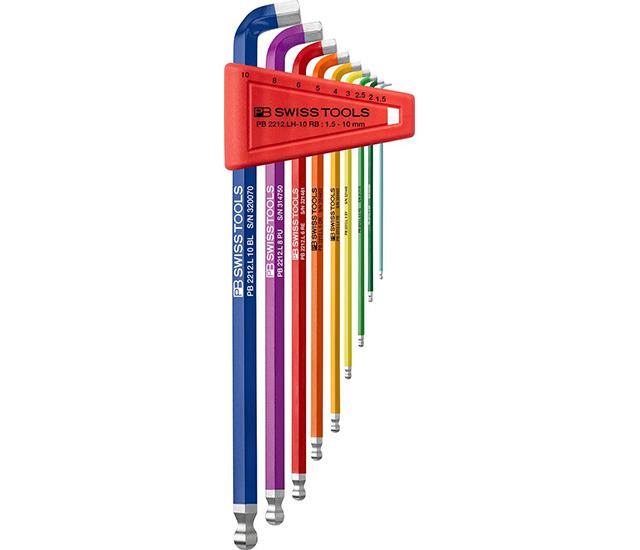
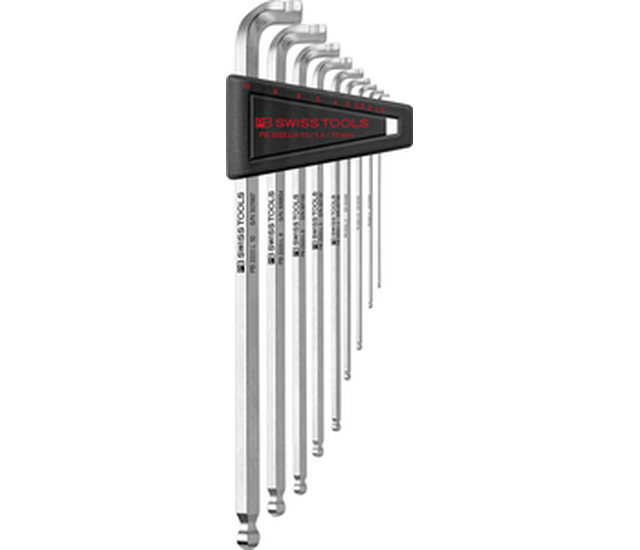
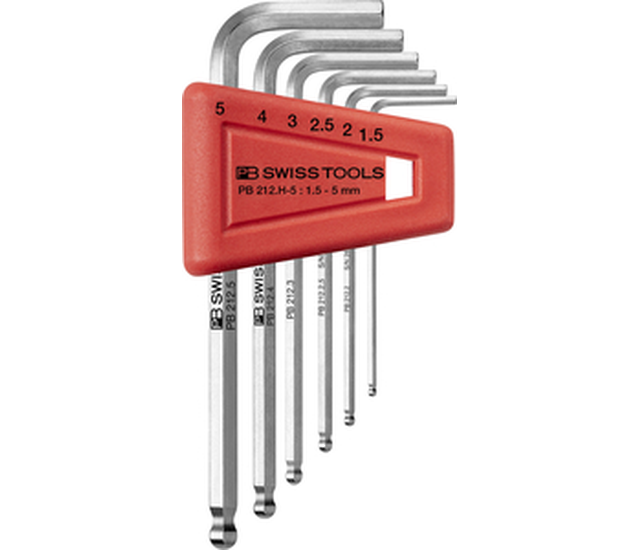
Differences Between PB 212 H, PB 2212.LH, and PB 2222.LH
Working Space Challenges with Hex Keys
Three models, while seemingly similar on the workbench, reveal their differences when the short end approaches the framework of equipment. The amount of wrist rotation space becomes crucial in these moments. PB 212 H, PB 2212.LH, and PB 2222.LH are all ball-point hex keys from PB Swiss Tools, yet their design variations can highlight distinct advantages in specific operational contexts.
For this application, continue with PB Swiss Tools hex keys.
PB 212 H

The PB 212 H features a long end equipped with a ball point, allowing for turning hexagon socket screws at an angle of up to 30°. This design enables flexibility without requiring the tool to be perfectly vertical, making it suitable for general work environments. When the work position allows for free movement of the L-shaped wrench, the PB 212 H efficiently completes tasks without compromising its utility in various scenarios.
PB 2212.LH

In contrast, the PB 2212.LH has a short end designed at a 100° angle, which significantly enhances the wrist's turning space when the tool is near the surface of the equipment. While retaining the ball point on the long end, the short end's design can influence the relative position of the gripping end to surrounding structures when approaching screws. If the issue is merely a slight angle deviation of the screws, the ball-point design of the PB 212 H suffices. However, when the space for wrist movement is restricted, the advantages of the PB 2212.LH become apparent.
Cross-check the cited specifications and technical data with the PB Swiss Tools official source.
PB 2222.LH

The PB 2222.LH offers an adjustable short end ranging from 90° to 100°. This feature enables it to adapt to varying work environments. When facing obstacles from different directions, users can adjust the tool to fit the workspace, avoiding forced wrist positions caused by a fixed angle. This flexibility can be a significant advantage in many operational settings where space is constrained.
How to Choose the Right Model
When selecting the appropriate tool, consider the source of limitations. If the screw axis isn't aligned but there is still sufficient wrist rotation space, the PB 212 H's ball point may be adequate. If the short end can fit into the screw but the long end is too close to the work surface, the 100° design of the PB 2212.LH may be warranted. In scenarios where interference directions are not fixed, the adjustable short end of the PB 2222.LH should be considered. For confirmation of PB Swiss Tools models and applications in Taiwan, Hanna can assist users in ensuring the correct choices based on actual screw positions and surrounding distances.
Key Technical Insights
PB 2212.LH 採固定 100° 短端;PB 2222.LH 的短端可在 90° 到 100° 間調整。差別在於工作位置是否需要因不同干涉方向改變短端角度。
不一定。若球頭斜向操作已能解決問題,PB 212 H 可能已足夠;若短端旁的手部空間或工作面干涉才是限制,PB 2212.LH 的 100° 短端才會出現差別。
當短端已能插入螺絲,但長端太貼近設備表面、框架或護罩,讓手指與轉動路徑不足時,100° 設計的差異才會明顯。
不是單純的升級關係。PB 2212.LH 是固定 100°;PB 2222.LH 提供 90°–100° 可調短端,是否需要取決於干涉方向是否會改變。